
Like Braga, Guimarães is one of the main destinations for tourists arriving in the Minho region, in Portugal. The city is considered the cradle of Portuguese nationality: it was there that Afonso Henriques, the first king of the country, conqueror and unifier of Portuguese territories, was born. For that reason alone, perhaps the visit would be worth it, but Guimarães also offers medieval monuments, a small, charming and cozy historic center, as well as museums, good restaurants, conventual sweets and is also a great option for a day trip from Porto.
What to do in Guimarães
You can summarize tourism in Guimarães in three regions: the historic center, the Castle and Paço dos Duques de Bragança area (which is, in fact, close to the center), and also the highest part, which includes the cable car and from Penha Park. All journeys can be made on foot.
If you arrive in Guimarães by train, it will only take a 10-minute walk to reach the Historic Center. The first stop will be at Largo do Toural, where the Customs Tower is located with the famous sign “Portugal was born here”. From then on, just head down the narrow streets and stroll through one of the most pleasant cities in Portugal.
In Largo da Oliveira, the attractions are the Nossa Senhora da Oliveira Church (where it is possible to visit the Sacristy and the High Choir) and the Padrão do Salado, a Gothic monument that would have been erected in the 14th century to commemorate the battle against the Moors. If you have time, take the opportunity to have a coffee or a meal around this square, which is certainly one of the most interesting spots in the city.
Next to the church, there is the Alberto Sampaio Museum, which houses important sculptures and artistic works that belonged to churches in Guimarães. And for those who want to discover an art that is very characteristic of the city, our recommendation is to visit Loja Oficina, on Rua da Rainha. There, artisans work daily on the famous and charming embroideries of Guimarães, which have stitches, colors and a unique history – the staff is very friendly and interested in talking about this art which, unfortunately, is increasingly rare.
Anyone heading from Largo da Oliveira along Rua de Santa Maria will pass by the Guimarães Tourism Office and then Casa Costinhas, one of the most traditional pastry shops in the city. Treat yourself: come in and try the Torta de Guimarães (a puff pastry filled with eggs, almonds and chila jam, similar to pumpkin) and the Toucinho do Céu (which has practically the same ingredients as the pie, but is more cute). Another place to melt with sweets is Pastelaria Clarinha, in Largo do Toural.
Guimarães Castle
Following Rua de Santa Maria, you will soon reach the so-called Colina Sagrada, where the Guimarães Castle, the Paço dos Duques de Bragança and the Church of São Miguel do Castelo are located.
Allow at least an hour and a half to visit Guimarães Castle and Paço dos Duques. The first was built in the 10th century, served as protection for the city and, later, gained even more fame for being the place where the first king of Portugal, Afonso Henriques, was born. The tour of the castle includes walking through and over the ruins and climbing one of the central towers, where an exhibition has been set up with the most important historical facts of the region.
On the way between the castle and the palace, you will pass the Church of São Miguel do Castelo, a very small building where the first king of Portugal was baptized. In the Palace, the largest of the buildings on Colina Sagrada, there are large spaces with antique furniture, tapestries, porcelain, various medieval Portuguese artifacts and a beautiful wooden chapel. The palace was built in the 15th century, at the behest of D. Afonso, bastard son of King D. João I, and served for years as a manor house. It’s cool to walk around there and get an idea of how the nobility lived centuries ago.
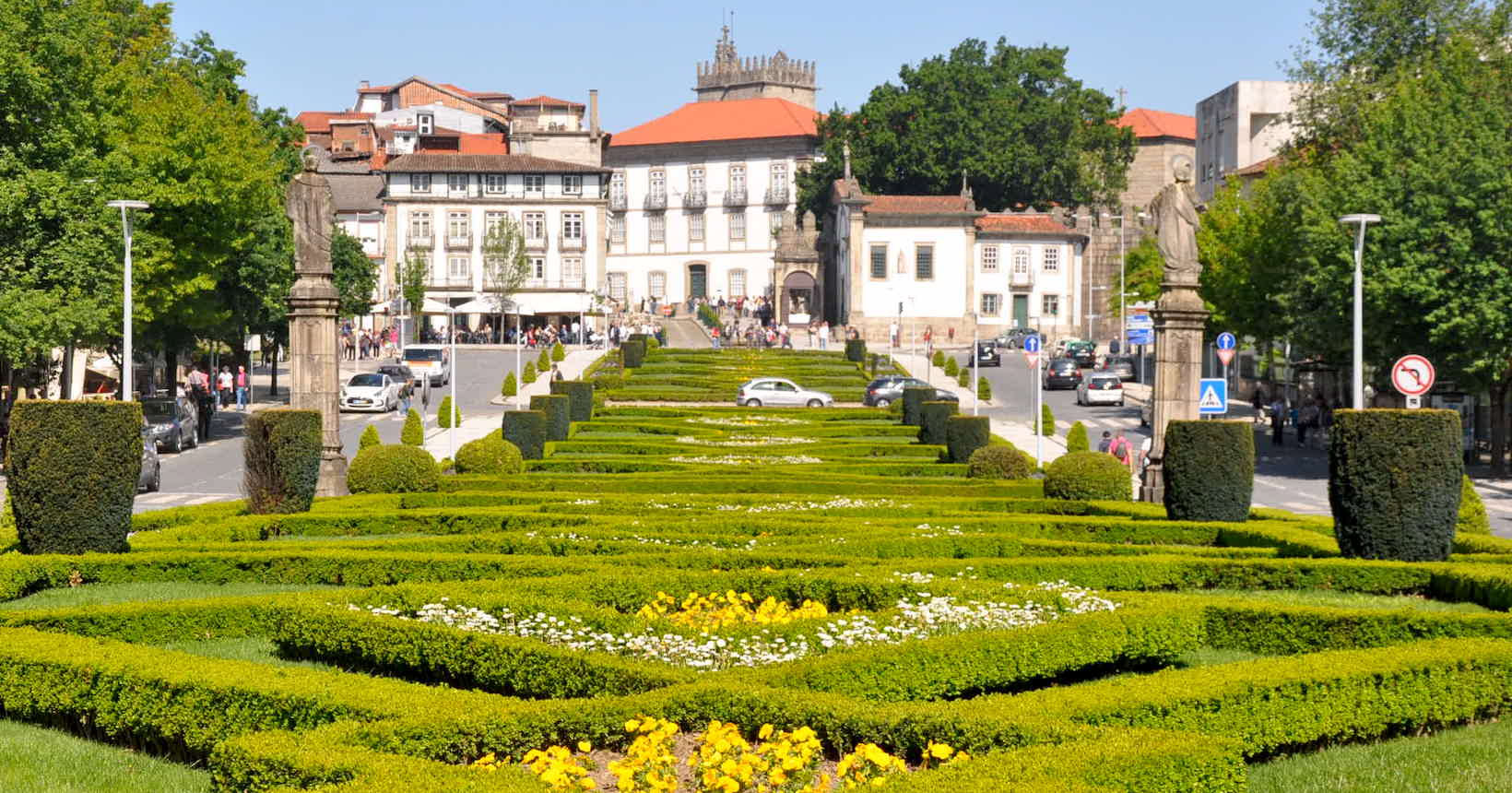
Then, return to Largo da Oliveira and follow the street in front of the Alberto Sampaio Museum. You will find yourself in an extensive and flowery garden, Largo da República do Brasil, at the end of which is a beautiful church, Nossa Senhora da Consolação.
If the idea is to take the aerial cable car (round trip costs 7.50 euros) and go to Penha Mountain, where the Penha Sanctuary is located, an extensive green area for camping and several viewpoints with beautiful views over the city, just continue to the Guimarães Cable Car.
Those who prefer to continue their tour through the lower part of the city can go to the right of the Church and go to the Leather Zone, where there are, in the open air, old tanks and structures from the tanning industry, one of the city’s main economic activities in the first place. half of the 20th century.
Close to this area, there is also the Church of São Francisco, which has a very beautiful interior and free entry.
Guimarães also has several museums, such as Ciência Viva, the José de Guimarães International Arts Center and the Martins Sarmento Archaeological Museum.
In summary, Guimarães is undoubtedly one of the most beautiful and interesting cities in Portugal and is certainly worth a visit.